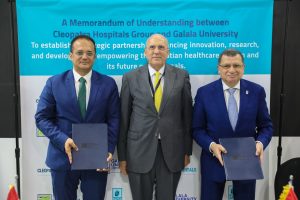
Signing Ceremony of Cooperation Agreement with Cleopatra Hospitals Group and the Egyptian Healthcare Authority
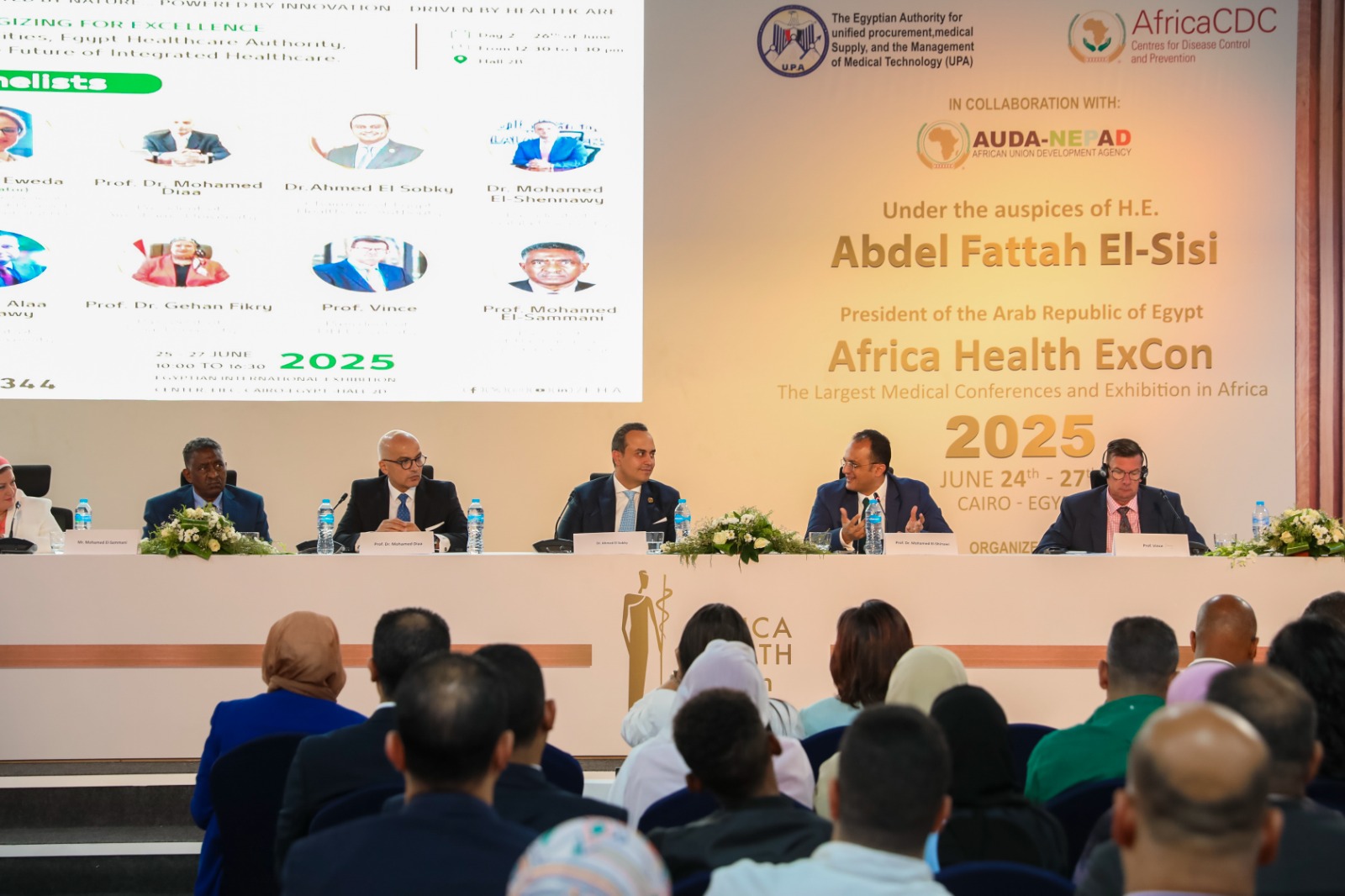
At Africa Health ExCon 2025 in Al Manara International Conference Center, Galala University formalized a tripartite cooperation agreement with Cleopatra Hospitals Group and the Egyptian Healthcare Authority (EHA)—a practical alliance designed to move students from lecture halls into real clinics, and to channel university research into measurable improvements in patient care.
The agreement creates a structured pathway for clinical training across medicine, pharmacy, nursing, and applied health sciences. Students will rotate through EHA facilities and Cleopatra hospitals under defined supervision ratios, competency checklists, and patient-safety protocols. Faculty and hospital preceptors will co-design rotation plans so that skills—triage fundamentals, medication safety, infection control, imaging workflows, health IT literacy—are mastered in real settings, not just simulated labs.
On the innovation front, the partners will back joint R&D projects in areas such as digital transformation, remote monitoring, and AI-assisted diagnostics. Each project will follow a translational model: clear problem statement from clinical practice, shared data governance, ethics review, and outcome metrics like reduced wait times, lower error rates, or improved continuity of care. Early priorities include interoperability for care pathways and decision-support tools that assist overburdened clinical teams.
The agreement also elevates capacity building. Short courses and micro-credentials—co-taught by GU faculty and clinical leaders—will support continuous professional development for healthcare workers in Egypt, with a focus on practical, standards-driven training that can be deployed at scale. Knowledge exchange will be two-way: clinicians inform curricula with frontline realities; academics provide evidence synthesis, evaluation frameworks, and new methods.
“Our goal is to align education with outcomes,” noted university leadership during the signing. “When students train where care happens, they learn faster—and patients benefit sooner.”
This collaboration advances:
-
Student readiness: competency-based rotations with audit trails and feedback loops.
-
Clinical quality: shared protocols and evaluation dashboards focused on safety and service.
-
Research impact: pilots that move from paper to ward with measurable, patient-facing results.
-
National priorities: stronger pipelines of skilled graduates supporting Egypt’s modernizing health system.